ERROR HANDLING & DEBUGGING
ORDER OF EXECUTION
To find the source of an error, it helps to know how scripts are processed. The order in which statements are executed can be complex; some tasks cannot complete until another statement or function has been run:

EXECUT.ION CONTEXTS
- EXECUTION CONTEXT JavaScript Hello Molly Every statement in a script lives in one of three execution contexts:
-
GLOBAL CONTEXT Code that is in the script, but not in a function. There is only one global context in any page.
-
FUNCTION CONTEXT Code that is being run within a function.Each function has its own function context.
-
EVAL CONTEXT (NOT SHOWN) Text is executed like code in an internal function called eval ()
- VARIABLE SCOPE The first two execution contexts correspond with the notion of scope :
-
GLOBAL SCOPE If a variable is declared outside a function, it can be used anywhere because it has global scope. If you do not use the var keyword when creating a variable, it is placed in global scope.
-
FUNCTION-LEVEL SCOPE When a variable is declared within a function, it can only be used within that function. This is because it has function-level scope
ERROR OBJECTS
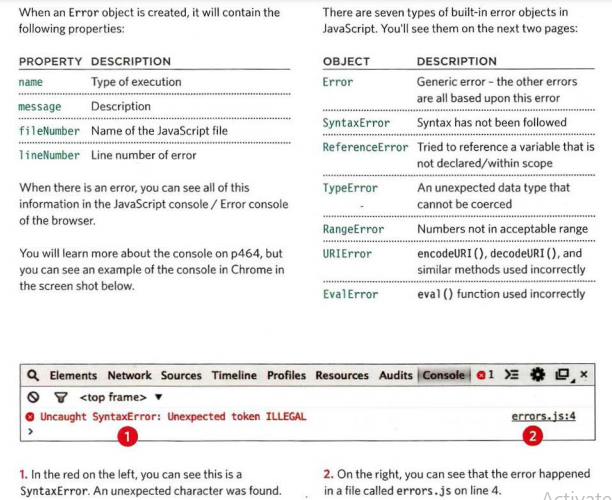
Error objects can help you find where your mistakes are and browsers have tools to help you read them.
Summary :
-
If you understand execution contexts (which have two stages) and stacks, you are more likely to find the error in your code.
-
Debugging is the process of finding errors. It involves a process of deduction.
-
The console helps narrow down the area in which the error is located, so you can try to find the exact error.
-
JavaScript has 7 different types of errors. Each creates its own error object, which can tell you its line number and gives a description of the error.
-
If you know that you may get an error, you can handle it gracefully using the try, catch, finally statements. Use them to give your users helpful feedback.